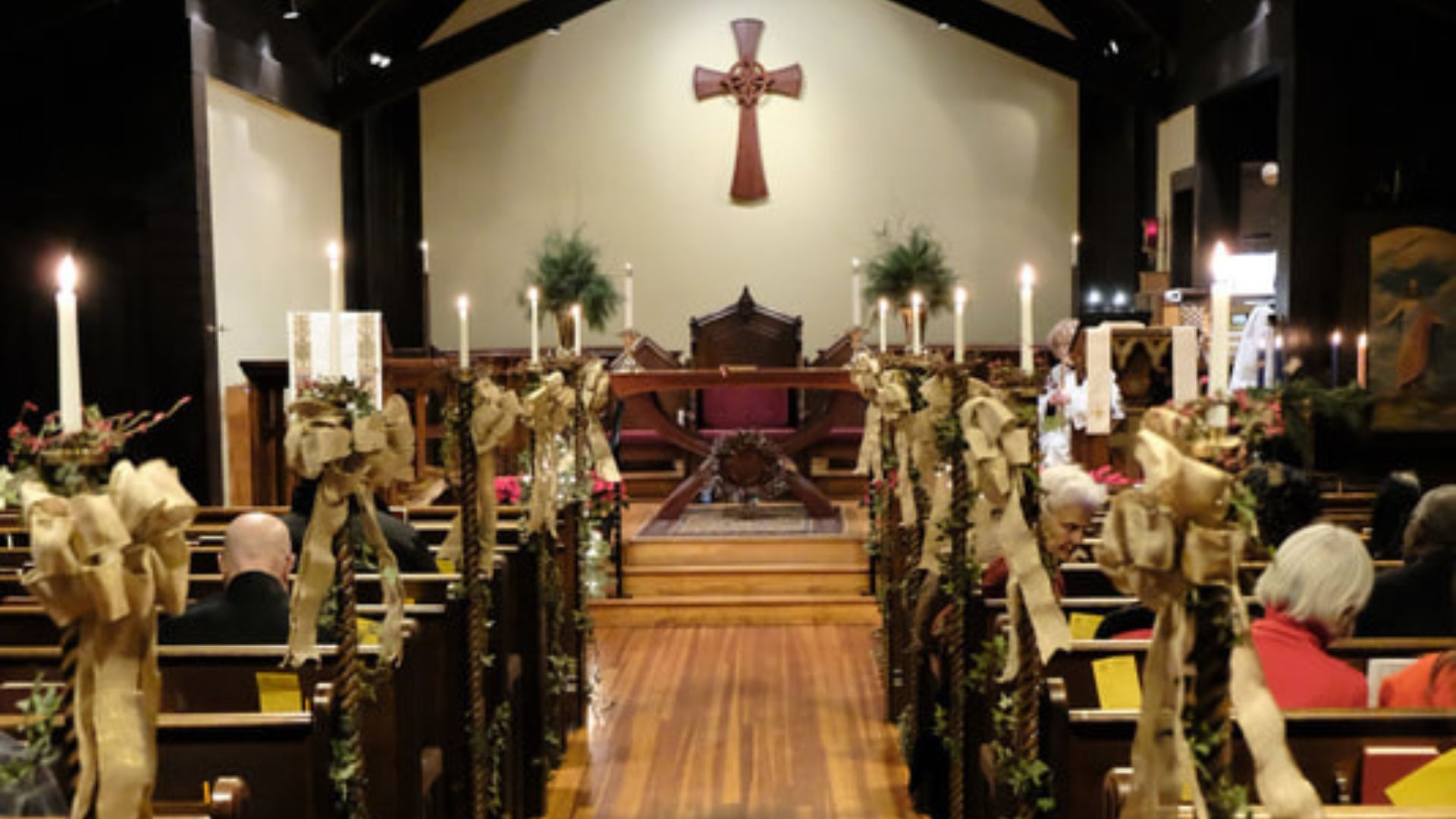
Photo courtesy of St. John’s Episcopal Church
Some of my fondest childhood memories of church revolve around the season of Advent. Each week at St. John’s Episcopal Church in Montclair, NJ, the children would carefully move Mary, Joseph, and their donkey one windowsill closer to the empty creche in the front of the sanctuary. After church we all stayed to practice for the annual Christmas pageant that would be performed at the 5:30 service on Christmas Eve. On the Saturday prior to Christmas Eve [and no sooner because Christmas begins December 25!!!], a group would gather to “Green the Church” and install beautiful, tall wooden spindle candlesticks to the pews along the center aisle, polishing the brass tops that held each candle. Finally, on Christmas Eve, I would operate the spotlight during the Christmas pageant. Believe it or not, I was a very shy and reserved child and would never have stood up in front of people, especially in a costume!
I share these examples not simply to wax nostalgic, but to illustrate that for me, the waiting of Advent was never passive. The rituals and activities of my church taught me that there was work to do. Preparing for the arrival of Jesus felt very real and worthwhile.
The word from the prophet in Isaiah 2:1-5 has always stood out to me for its vivid depiction of Advent hope; a hope we must cling to and work towards as the people of God. For context, the prophet speaks this word during a rather hopeless time for God’s people. Judah was amid a particularly difficult war. The city of Jerusalem had been laid siege by enemies and life was not going particularly well. So, King Ahaz looks to the prophet for a word of assurance and hope. And Isaiah does not disappoint:
The word that Isaiah, son of Amoz, saw concerning Judah and Jerusalem.
2 In days to come
the mountain of the Lord’s house
shall be established as the highest of the mountains,
and shall be raised above the hills;
all the nations shall stream to it.
3 Many peoples shall come and say,
“Come, let us go up to the mountain of the Lord,
to the house of the God of Jacob;
that he may teach us his ways
and that we may walk in his paths.”
For out of Zion shall go forth instruction,
and the word of the Lord from Jerusalem.
4 He shall judge between the nations,
and shall arbitrate for many peoples;
they shall beat their swords into plowshares,
and their spears into pruning hooks;
nation shall not lift up sword against nation,
neither shall they learn war any more.
5 O house of Jacob,
come, let us walk
in the light of the Lord!
This highly visible manifestation of Zion – the city of God – becomes an image of hope for a day when God would dwell among God’s people. It unveils a picture of a day marked by justice and the end of all violence and war, where there is no longer need for walls of protection or weapons for defense.
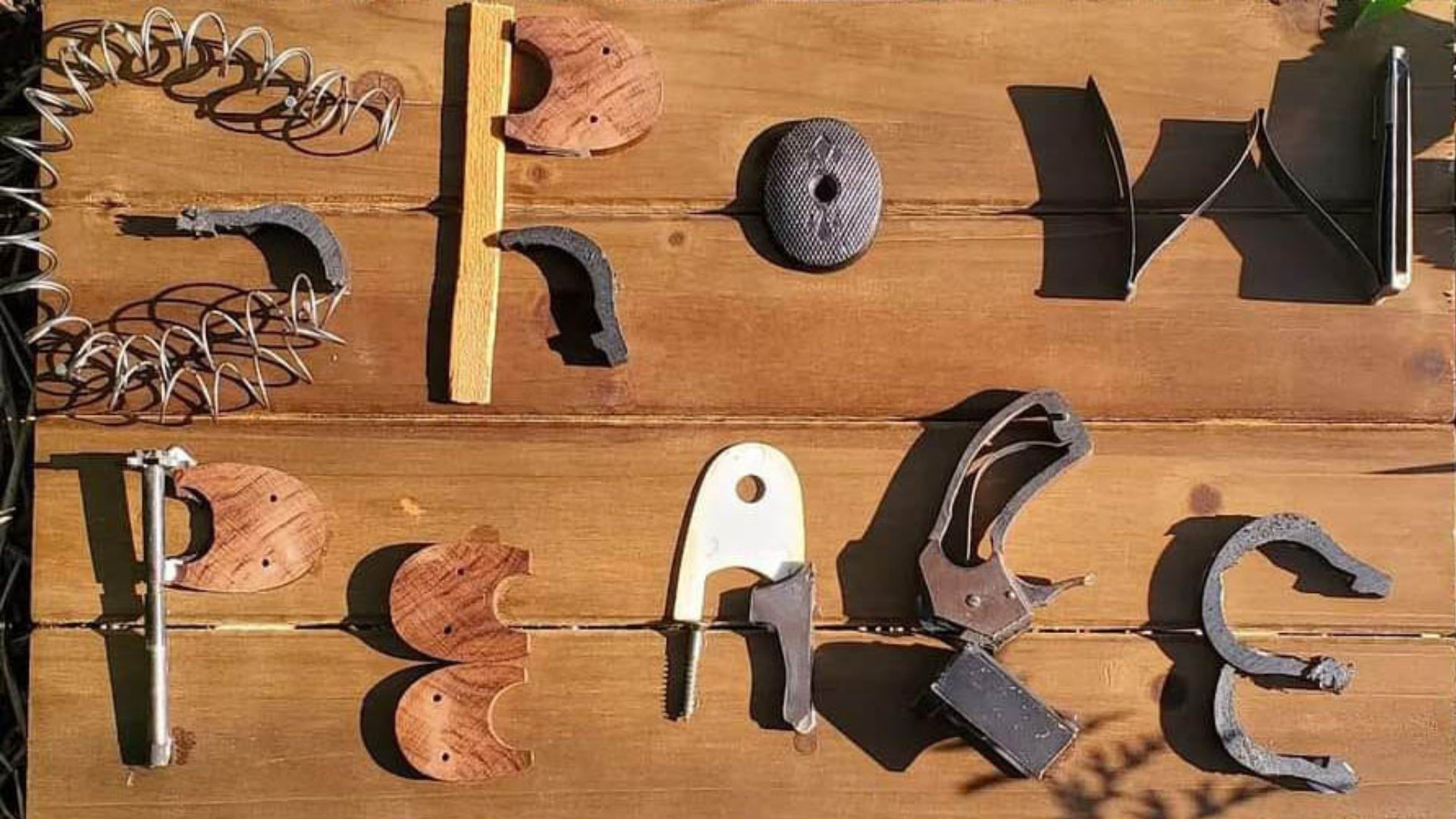 Photo courtesy of RAWtools
Personally, I find this vision wildly compelling as it fulfills our deepest longing for peace amidst the chaos of life. I love the way the late theologian Walter Brueggemann animates the
prophet’s word when he wrote:
“The old city is full of blacksmiths who have so much work to do. Listen and you can hear the hammer on the anvil. The smiths are beating and pounding iron, reshaping it, beating swords into plowshares and spears into tools for orchards. They are decontaminating bombs and diffusing the great weapons systems. The fear is dissipating. The hate is collapsing. The anxiety is lessening. The buildup of competitive threat is being reversed. The nations are returning to their proper vocation – care of the earth, love of creation, bounty for neighbor, enough for all, with newness, deep joy, hard work, all because the vicious cycles are ended and life becomes possible.” 1
I don’t know about you, but I need this vivid image of hope during Advent, especially this year. For we are living through a time of cataclysmic climate change, divisive and abusive political behaviors, unjust racial profiling of US citizens, violent detaining of immigrants with no criminal record, deportations without cause or due process, extra-judicial killings in the Caribbean, unchecked support of nations committing genocide, healthcare being ripped away with no alternative being offered, and the purposeful acceleration of income inequality through cuts to the most vulnerable. I could go on, but it is not good for my soul to dwell too much on these things.
Suffice it to say, this Advent might best be visualized by the image of Jesus weeping. Nevertheless, I cling to the memory of the work of Advent past and commit myself to the work of Advent present. I need to keep what the prophet saw in front of me at all times. For it was and still remains a hope-filled word… an Advent vision waiting to become reality… a clarion call that compels us not to sit back to wait and see, but rather propel us into the deep and meaningful work of justice and peace, of accompaniment and protest, of participation in the building of God’s Kin-dom where only Christ is King, and compassion and love for the outcast and the “other” leads the way.
I started by recalling my Advent memories of purposeful work. I share them not as a call for the return of Christmas pageants or re-instituting particular rituals, as wonderful as they can be. The rituals of my childhood would eventually develop in me a call to action… to not simply believe in Jesus, but to be his hands and feet. So I share them to keep me grounded in the call to follow Jesus, our brown-skinned, Palestinian Savior, whose love was embodied through action.
May God grant us the gift of such purposeful action as we journey together this Advent season!
1 “Celebrating Abundance: Devotions for Advent” by Walter Brueggemann. Westminster John Knox 2017. pages 10-11.